If you’ve been living with a denture that shifts, or you’ve just been told you’re going to need dentures, it’s normal to have a lot of questions. A traditional denture? A “snap-in” one on implants? Fixed teeth like All-on-4? Each option has real advantages and real limits. Here we explain them calmly and plainly, so you arrive at your appointment knowing what to ask.
One note before we start: this guide is general information. The right option for you depends on your bone, your gums, your overall health and your budget, and that can only be decided with a professional evaluation.
This is the classic removable denture. It rests on the gums and, on the upper arch, covers the palate. It stays in place thanks to the shape of the gums and suction, sometimes with a little adhesive. You take it out to clean it and, usually, to sleep.
It’s also a removable denture, but underneath it has snaps or attachments that fit onto implants placed in the bone. It “clicks” into place and moves much less. You still take it out to clean it and usually to sleep.
This is a full arch of teeth screwed onto several implants, usually four or more. You don’t take it out at home: only the dentist can remove it during checkups. On the upper arch, it doesn’t cover the palate.
| Feature | Conventional denture | Snap-in (overdenture) | Fixed (All-on-4) |
|---|---|---|---|
| Stability when eating and speaking | Can shift, especially the lower one | Much more secure; may have slight movement | Fixed; doesn’t move |
| Palate (upper arch) | Covers it | Sometimes it can be reduced, depending on the case | Doesn’t cover it |
| Cleaning at home | Take it out and brush it outside your mouth | Take it out; also clean the snaps and implants | Cleaned in the mouth with special brushes, plus professional checkups |
| Approximate timeline | Several visits over a few weeks | Several months (implants, healing and prosthesis) | Several months (temporary first, final later) |
| First few months | Sore spots, adjustments and possible relines | Adjustments and getting used to the snaps | Adapting to the temporary prosthesis and a soft diet at first |
| Long-term maintenance | Relines and replacement as the gums change | Periodic replacement of the snap parts | Checkups and possible repairs to the prosthetic teeth |
| Published price per arch | $2,000–3,500 | $10,000–15,000 | $22,000–30,000 |
Prices are Miami market ranges, per arch, without insurance. The price for your case depends on what the evaluation shows (for example, whether extractions or a bone graft are needed), and it should be given to you itemized and in writing before you start.
This is the difference you notice most day to day. With a conventional denture, the upper one usually holds fairly well thanks to the palate. The lower one is another story: the tongue and muscles push it around, and many people feel it “dances” when they chew meat, bread or anything hard. You can learn to eat with it, but it takes practice.
A snap-in denture changes that feeling a lot, because the implants anchor it. Most people can bite with more confidence and talk without worrying it will come loose. The fixed option feels the most like having your own teeth: it doesn’t move, and you don’t have to think about it when you eat or laugh.
The upper plate covers the palate to create suction. Some people don’t mind; others find it makes them gag, changes how they sense the taste or temperature of food, or simply feels uncomfortable. With a snap-in denture, depending on how many implants are placed, that coverage can sometimes be reduced. The fixed prosthesis leaves the palate free.
The conventional denture is the simplest: take it out, brush it, put it in its case and clean your gums. The snap-in adds a step: thoroughly cleaning the implants and attachments, because plaque builds up there. The fixed one doesn’t come out at home, so cleaning is done inside the mouth with special brushes or a water flosser, and it’s important to keep up with professional checkups. If you have limited strength or mobility in your hands, tell the dentist: it affects which option is most practical for you.
A conventional denture usually takes several visits: impressions, bite records, a try-in before it’s finished, delivery and adjustment checkups. With implants the path is longer, because the bone needs time to bond with the implant before the final prosthesis is loaded. In many All-on-4 cases, a temporary prosthesis is placed the same day; the final teeth come months later. Always ask what each phase includes and when it ends.
With any new prosthesis there’s an adjustment period. It’s common to notice sore spots or small sores, to speak a little differently for the first few days, or to produce more saliva. That gets fixed with adjustments. If your teeth are extracted and you get an immediate denture, the gums change a lot while they heal and the denture gradually gets loose: that’s why relines are done (refitting the base to the gums) and, sometimes, a new denture later on. It isn’t a failure; it’s part of the process.
It’s one of the most common questions. In the lower jaw, the bone at the front is usually dense, and two implants are often enough to hold a snap-in denture and give it much more stability. In the upper jaw, the bone tends to be softer and less dense, and the prosthesis takes different forces, so more implants are usually needed to get a similar result.
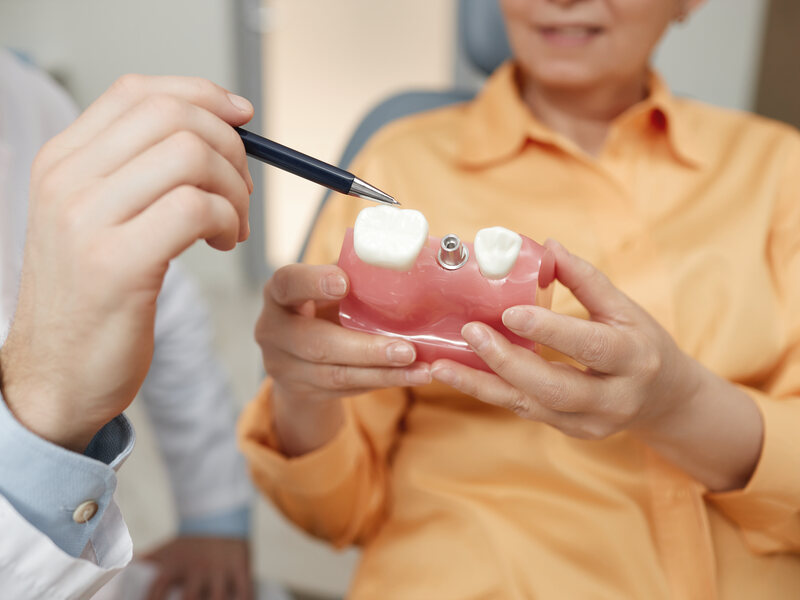
This is a general rule, not a prescription. The actual number of implants is decided by looking at your bone on a 3D scan, and the dentist should be able to show you why they’re recommending that number.
No prosthesis lasts forever. A conventional denture wears down and, since the gums and bone change over the years, it needs relines and, eventually, replacement. With a snap-in denture, the retention parts wear out and are replaced periodically, and the denture itself ages too. A fixed prosthesis, well cared for, can last many years, although the prosthetic teeth may need repairs. In all three cases, regular checkups are what extend their life the most.
PureSmile Miami opens November 1, 2026 in Kendall. We’ll explain the options that make sense for your case, in English or Spanish, and answer your questions. We’ll verify your plan for free and give you the price in writing before we start, so you can decide with peace of mind. Write to us here and we’ll get in touch.