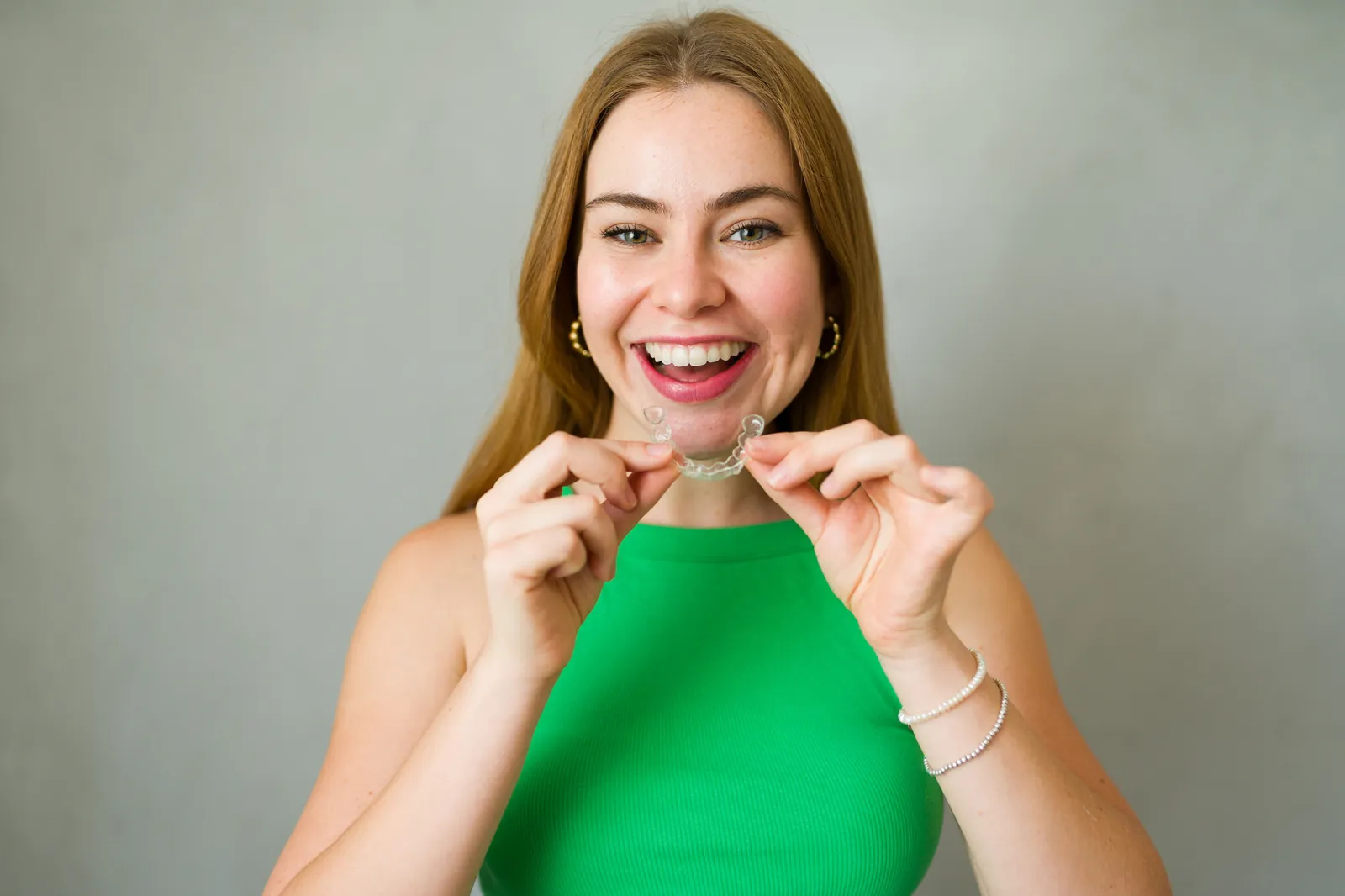
Dental retainers hold your teeth in their new position after braces or clear aligners. Without one, teeth tend to drift back toward where they started, which is called relapse. Most people wear a retainer almost full-time at first, then only at night, and in many cases for years.
After months or years of treatment, it is natural to want to be done with appliances. But your retainer is what protects that new smile.
The bone around your teeth keeps renewing itself throughout life, and chewing and speaking put steady pressure on your teeth. That is why they can slowly shift back unless something holds them in place, according to the American Association of Orthodontists (AAO).
The highest risk is right after treatment ends, while the bone and gums are still settling (AAO). MedlinePlus puts it simply: you will need a retainer to stabilize your teeth after braces.
The ADA mentions it on MouthHealthy too: braces are followed by a period of retainer wear. And a 2023 Cochrane review says the same: without a retention phase, teeth tend to relapse.
There are three main types, and each has trade-offs (AAO).
A thin wire bonded to the back of your teeth, usually the lower front teeth.
The classic retainer: an acrylic base with a wire across the front teeth.
A custom-made clear plastic tray that fits over your teeth.
The Cochrane review pooled 47 studies with 4,377 participants. Differences between retainer types were small, and the evidence was low or very low certainty. In other words, no single approach has been shown to be clearly superior.
For example, compared with a fixed retainer, a clear retainer worn full-time was linked to less gum bleeding but more failures. The right choice depends on your case and your habits, so make it with your dentist or orthodontist.
Your orthodontist sets your exact schedule. But the usual pattern the AAO describes looks like this:
On its retainers page, the AAO adds that a retainer is typically needed for a lifetime, though you may wear it less often over time. It also warns that skipping it, even for a few days, can lead to noticeable shifting.
Cochrane found only one small study comparing part-time and full-time Hawley wear, and it showed no difference. That is thin evidence, so do not change your schedule without talking to your orthodontist.
A dirty retainer collects bacteria. Here is the routine from the AAO's retainer cleaning guide:
The wire traps plaque easily. Clean under it every day with a floss threader, a small interdental brush or a water flosser (AAO). Plaque left there can harden into tartar and lead to bleeding gums.
This is very common. Maybe you had braces as a teen, stopped wearing your retainer, and now your lower front teeth look more crowded. The AAO explains that teeth can keep moving well into adulthood. Over the years, lower teeth tend to crowd, while gaps may open between upper teeth.
We walk through the options in adult orthodontics in Kendall.
Schedule a checkup if any of these apply:
When not to wait: if you have severe pain with facial swelling or a fever, call your dentist the same day. If you have trouble breathing or swallowing, or heavy bleeding that will not stop, call 911 or go to the emergency room (AAO). More in dental emergency in Kendall: what to do.
PureSmile Miami opens on November 2, 2026, at 8000 SW 117th Ave, Suite 100, in Kendall. At your first visit, our dentist checks how your retainer fits and whether your teeth have shifted. Then they walk you through your X-rays to explain whether an adjustment or a new retainer is enough, whether orthodontics or aligners make sense, or whether your case calls for a referral to an orthodontist. We see patients in English or Spanish, verify your insurance for free and give you a written treatment plan before we start.
Join the waitlist or call us at (305) 787-3642.
Usually almost full-time for the first few months, then only at night. According to the AAO, many people need a retainer for life. Your orthodontist sets your schedule.
Your teeth tend to drift back toward their old position. The AAO warns that even a few days without it can lead to noticeable shifting.
It depends on your case. A fixed retainer cannot be forgotten but is harder to clean; a removable one only works if you wear it. The Cochrane review found no firm evidence favoring either one.
Rinse it with lukewarm water and brush it with a soft brush and mild dish soap, plus a weekly soak in a retainer cleaner. Avoid toothpaste and hot water.
If it is only a little snug, the AAO suggests wearing it more often for a few days. If it will not go in, hurts or stays tight, do not force it and book a visit.
Not with a removable one: take it out to eat and put it in its case. With a fixed retainer you can eat, but avoid hard or sticky foods.
General information; not a substitute for an in-person evaluation. Sources: American Association of Orthodontists (AAO); Cochrane (Martin, Littlewood et al., 2023); MedlinePlus; MouthHealthy (ADA). Yoan Suárez Zayas, DMD · FL Lic. DN 21413.





